Berkeley has a particularly broad mix of students, educators, healthcare professionals, families, businesses, and community organizations, so the reason someone searches for CPR or First Aid training can vary considerably. A university student may need CPR training for a clinical or professional program, while a teacher, childcare provider, workplace employee, coach, or caregiver may be looking for practical emergency-response education.
American Red Cross CPR and First Aid classes provide different types of training depending on the course selected. CPR courses focus on responding to cardiac and breathing emergencies, while First Aid training addresses a broader range of emergency situations. Some courses combine First Aid, CPR, and AED education. The Red Cross currently lists CPR classes in Berkeley in online, in-person, and blended formats, with in-person and blended options including hands-on skills practice.
For someone searching for American Red Cross CPR and First Aid certification classes in Berkeley, the most important first step is identifying the training requirement and then choosing a course that matches it.
Quick Answer: Finding the Right CPR or First Aid Course in Berkeley
People in Berkeley can explore American Red Cross CPR, First Aid, CPR/AED, and combined First Aid/CPR/AED training depending on their workplace, educational, professional, childcare, or personal needs. The appropriate course depends on what skills and certification an employer, school, healthcare organization, or other program requires.
If you are taking a course for a specific job or educational program, verify the requirement before registering rather than assuming that every CPR or First Aid course is interchangeable.
What Do American Red Cross CPR and First Aid Classes Cover?
CPR and First Aid training overlap in emergency preparedness, but they are not the same type of education.
CPR training concentrates on responding to cardiac and breathing emergencies. Depending on the selected course, training may address adult, child, and infant CPR, recognition of cardiac emergencies, and AED-related skills. The American Red Cross describes its Berkeley CPR/AED training as covering recognition and care for a variety of breathing and cardiac emergencies.
First Aid training has a wider scope. It focuses on recognizing and responding to situations requiring immediate assistance while appropriate medical care is obtained. The exact content depends on the particular course.
AED training complements CPR education by teaching participants about the use of an automated external defibrillator during appropriate cardiac emergencies. Some courses combine CPR and AED instruction, while broader programs combine First Aid, CPR, and AED training.
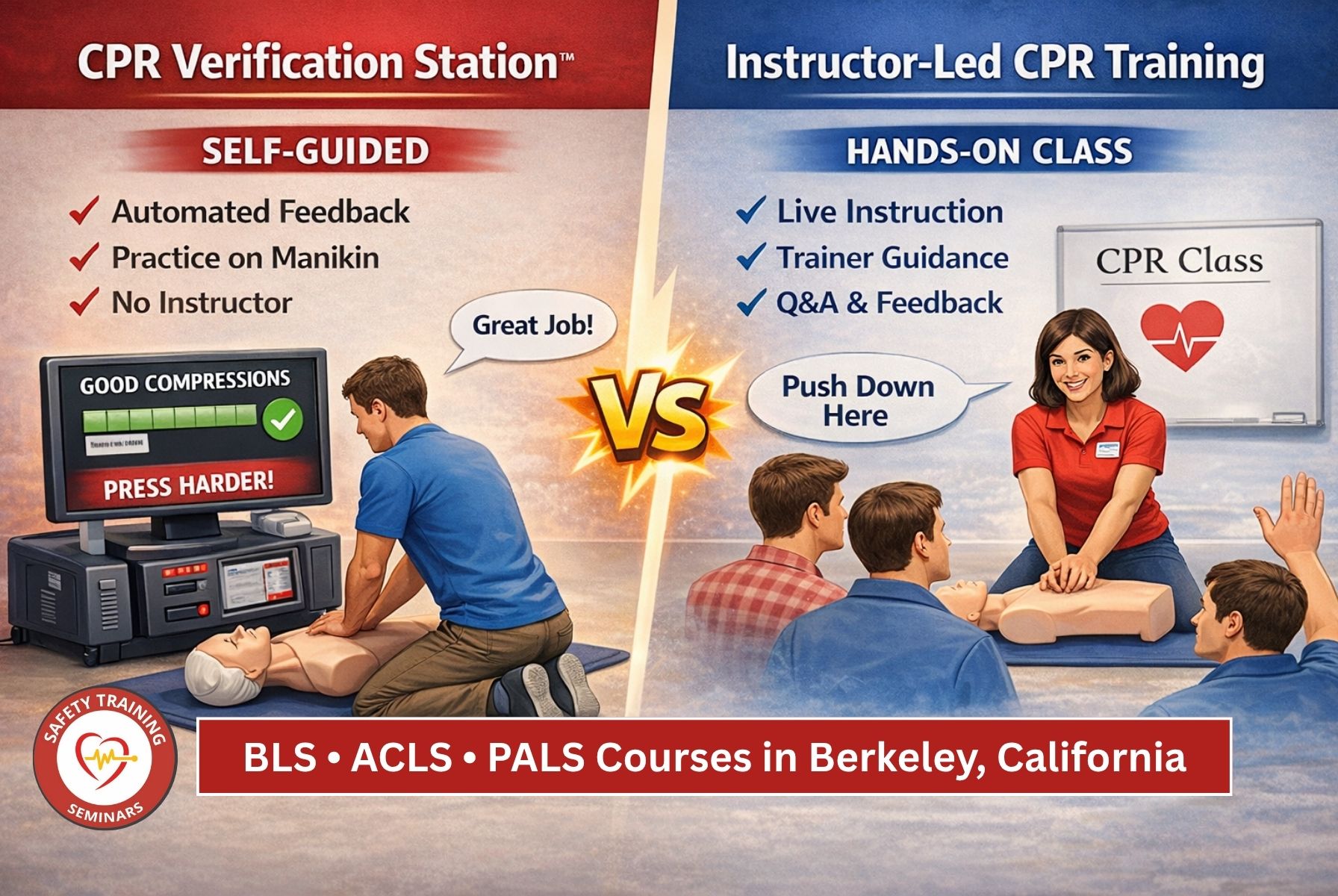
The format can also matter. The Red Cross currently describes in-person Berkeley CPR classes as including hands-on skills practice, while blended courses combine online learning with an in-person skills session. Its online-only option does not include in-person skills verification and may not satisfy some workplace requirements.
That makes it worth checking not only what a course teaches, but also how the training is delivered.
CPR Training for Berkeley Students, Professionals, and Employees
CPR training can be relevant to a wide range of people in Berkeley.
The city’s educational environment is one example. UC Berkeley includes programs spanning engineering, public health, education, optometry, social welfare, and many other fields. Students entering healthcare-related programs, clinical experiences, internships, or certain employment settings may encounter CPR training requirements as part of their academic or professional pathway.
For those individuals, choosing a course should begin with the requirements supplied by their program.
CPR can also be relevant to employees who have workplace emergency responsibilities. OSHA’s general industry standard addresses first-aid arrangements where a nearby medical facility is not available, while specific industries can have additional requirements.
In practical terms, an employee should not assume that taking any course will automatically satisfy an employer’s requirement. The workplace should identify the required training, format, and documentation.
For people comparing CPR training options in Berkeley, the course description should be reviewed alongside the requirement they have been given.
First Aid and AED Training in Berkeley
First Aid becomes especially relevant when the training need extends beyond cardiac emergencies.
Teachers and childcare workers may want broader emergency-response education because they supervise children. Coaches and fitness professionals work in environments where an emergency response plan may be important. Workplace employees may be designated to provide first aid, while parents and caregivers may seek training for personal knowledge.
Workplace requirements can vary significantly. OSHA states that, under its general industry standard, when an infirmary, clinic, or hospital is not in near proximity to the workplace, one or more people must be adequately trained to render first aid. OSHA also emphasizes that workplace first-aid programs should reflect the hazards and circumstances of the particular workplace.
This is one reason a combined First Aid/CPR/AED course can be useful for some learners. However, the correct choice depends on the specific role and requirement.
People researching First Aid and CPR training near Berkeley can use the available course information to compare training categories before making a registration decision.
Who Commonly Takes CPR and First Aid Classes in Berkeley?
Berkeley’s combination of higher education, residential neighborhoods, workplaces, community facilities, and regional transportation creates several potential audiences for emergency-response training.
University and Healthcare Students
Students may need CPR training for clinical programs, internships, employment, or other educational requirements. Berkeley’s extensive academic environment includes health-related and professional programs, making course verification particularly important for students entering specialized fields.
Teachers and Childcare Providers
People responsible for children may seek CPR and First Aid training because their employers or programs have specific safety requirements. The exact requirement should be confirmed with the school, childcare organization, or employer.
Workplace Employees
Businesses may designate employees to respond to emergencies or maintain workplace first-aid capabilities. OSHA requirements vary according to the workplace and industry, so businesses should determine their specific obligations rather than relying on a generic course assumption.
Coaches and Fitness Professionals
People supervising exercise, recreation, or athletic activities may benefit from emergency-response education. Whether a specific certification is required depends on the organization and role.
Parents and Caregivers
Parents, family caregivers, and others responsible for children or dependent family members may choose CPR and First Aid training for practical emergency-response knowledge.
Community Members
CPR and First Aid education is not limited to healthcare professionals. People may voluntarily pursue training for personal preparedness, community involvement, or general emergency-response skills.
CPR vs. First Aid vs. CPR/AED: Which Course Should You Choose?
The simplest way to compare the major categories is to look at the primary focus of each one:
| Training Type | Typical Focus |
| CPR | CPR-focused emergency-response education |
| First Aid | Broader response to emergency situations |
| CPR/AED | CPR training combined with AED-related education |
| First Aid/CPR/AED | Broader emergency-response training covering all three areas |
These descriptions are intended to explain the general purpose of each training category. They should not be treated as universal employment or legal requirements.
Before registering, check with the organization that requested the training. Depending on your situation, that could be:
- Employer or workplace safety coordinator
- School or university program
- Healthcare organization
- Licensing organization
- Professional organization
- Childcare provider or school administrator
- Internship or clinical program
This extra step can prevent someone from completing a course that does not meet the intended requirement.
A Berkeley Training Location for CPR and First Aid
For people who prefer to investigate training within Berkeley, Safety Training Seminars provides a local option associated with CPR and related emergency-response courses.
Safety Training Seminars — 1700 Solano Ave, Suite F, Berkeley, CA 94707
The Solano Avenue location gives people searching for Berkeley CPR training another local option to investigate. The appropriate course will depend on whether the learner needs CPR, First Aid, AED-related training, or a combination.
Berkeley’s transportation network includes public transit, BART connections, bicycle routes, and other ways of getting around the city, so location can also be a practical consideration when comparing training options.
Before enrolling, review the current course information and compare it with any requirement provided by your employer, school, or organization.
Why Consider Safety Training Seminars in Berkeley?
Safety Training Seminars can be considered by Berkeley residents, students, employees, caregivers, and professionals looking for a local training option.
The main consideration should be course fit rather than simply location. Someone who needs CPR/AED training may not need the same course as someone whose employer requires First Aid/CPR/AED training. Likewise, a student entering a healthcare program should confirm the program’s specific requirements before selecting a class.
For readers investigating local CPR classes in Berkeley, the relevant course information can help determine which training category to explore.
Frequently Asked Questions
What CPR training can I take in Berkeley?
American Red Cross CPR training is available in Berkeley through different learning formats, including in-person, online, and blended options. The exact course should be selected according to the learner’s needs. In-person and blended formats include a hands-on component, while online-only training may not satisfy every workplace requirement.
Does a First Aid class automatically include CPR?
No. First Aid and CPR are separate areas of training, although combined courses are available. If your employer, school, or organization asks for both First Aid and CPR, look specifically for a course that includes both rather than assuming that a First Aid-only class covers CPR.
Do UC Berkeley students need CPR certification?
Some students may need CPR training because of their academic program, clinical placement, internship, employment, or other requirements, but there is no single requirement that applies to every student. Students should confirm the specific training requirement with their department or program before registering.
Are hands-on CPR classes available in Berkeley?
Yes. The American Red Cross currently lists in-person Berkeley CPR courses with hands-on skills practice, as well as blended courses combining online learning with an in-person skills session. The exact format depends on the individual course.
Can Berkeley businesses require employees to have First Aid training?
Workplace requirements depend on the industry, worksite, hazards, and applicable regulations. OSHA’s general industry standard requires adequately trained first-aid personnel in certain circumstances where an appropriate medical facility is not in near proximity. Employers should evaluate their own workplace requirements rather than assuming that one rule applies to every business.
Where can I find CPR and First Aid training near Solano Avenue?
Safety Training Seminars has a Berkeley training location on Solano Avenue. People should review the current course information before registering and confirm that the selected training meets the requirement for their job, school, or organization.
Choosing CPR and First Aid Training in Berkeley
The right CPR or First Aid course depends on what you actually need to accomplish. CPR focuses on cardiac and breathing emergencies, First Aid covers a broader range of emergency-response situations, and combined courses bring multiple areas of training together.
For Berkeley students, educators, workplace employees, caregivers, healthcare-related learners, and community members, starting with the requirement is usually the most practical approach. Confirm the requested course with your employer, school, program, or organization before enrolling.
Once you know which type of training you need, you can review local options such as Safety Training Seminars and compare the available course information. For additional Berkeley CPR and First Aid course information, review the available training categories and select an option that matches your specific purpose.