Nurses wrapping up clinical rotations, teachers returning to campus, and shift workers across Berkeley, California often run into the same wall: the training they need requires hands-on time they can’t easily schedule. American Heart Association (AHA) Self-Guided Learning was shaped around that problem. It lets eligible learners move through the knowledge portion of a course on their own, then handle any required in-person skills separately. This article explains how the format works across BLS, ACLS, PALS, CPR, AED, and First Aid, which course tends to match which role, and how a Berkeley learner can line up the right option. You’ll also see why Self-Guided Learning is not the same as a purely online course — a distinction that matters, because many provider-level certifications still call for a hands-on skills check that an online-only program cannot provide on its own.
Key Takeaway
AHA Self-Guided Learning divides a course into an independent online knowledge portion and, for most provider-level courses, a required in-person skills session. The course you actually need depends on your role, your patient population, and what your employer, school, or licensing body requires — so confirm that requirement before enrolling rather than guessing.
What AHA Self-Guided Learning Actually Means
Self-Guided Learning refers to completing the educational, knowledge-based part of an AHA course independently and at your own pace, usually through an online module. What it does not mean is skipping the physical skills. For provider-level courses such as BLS, ACLS, and PALS, hands-on skills practice and a skills check with a qualified instructor are typically part of finishing the course. That in-person step is what separates this format from an online-only class.
A common path looks something like this:
- Choose the course that matches your role or requirement.
- Complete the online knowledge portion on your schedule.
- Attend a scheduled hands-on skills session where applicable.
- Pass the required skills check for provider-level courses.
- Receive the applicable course completion documentation or AHA eCard once the requirements are met.
The exact steps can differ by course. A workplace CPR/AED and First Aid class may be handled differently than a clinical provider course, so it’s worth confirming the specific format for the course you select before you register.
The Courses Available Through Self-Guided Learning
Basic Life Support (BLS) in Berkeley
BLS is generally intended for people whose work involves responding to cardiac and breathing emergencies at a professional level. That typically includes nurses, nursing students, physicians, EMTs, paramedics, medical assistants, and dental staff. It goes well beyond general public CPR — covering high-quality CPR for adults, children, and infants, team-based resuscitation, and airway support. Because so many Berkeley residents work in or commute to nearby hospitals and clinics, BLS is often the first certification healthcare employers ask for. Not every role requires it, though, so check what your specific position or program expects.
Advanced Cardiovascular Life Support (ACLS) in Berkeley
ACLS is built for healthcare professionals who manage adult cardiovascular emergencies — think rhythm recognition, medication decisions, and leading a resuscitation team. It’s commonly associated with emergency, critical care, and cardiology settings, but the requirement varies by role and workplace. A nurse in one unit may need it while a colleague in another does not. If you’re unsure whether ACLS applies to you, your clinical educator or supervisor is the right person to confirm it.
Pediatric Advanced Life Support (PALS) in Berkeley
PALS centers on emergency care for infants and children, covering pediatric assessment, respiratory emergencies, and pediatric resuscitation. It’s intended for healthcare professionals who treat younger patients — for example, staff in pediatric, emergency, or urgent-care environments. As with ACLS, whether you need PALS depends on your patient population and your employer’s expectations rather than a single universal rule.
CPR, AED, and First Aid in Berkeley
These courses are aimed at a broader audience than the clinical provider tracks. Teachers, childcare workers, coaches, fitness instructors, workplace safety volunteers, caregivers, and community members frequently take them to meet a job requirement or simply to be ready at home or work. CPR and AED training builds the ability to respond to sudden cardiac arrest, while First Aid covers everyday injuries and illnesses. If your workplace or school specifies a particular version — such as a Heartsaver-level course — verify that detail so you complete the one that will be accepted.
How to Choose the Right Course
Picking the wrong course wastes time and money, and it can mean redoing training. Use the general guide below as a starting point, then confirm the specifics with the organization that’s asking for the certification.
| Course | Typical Audience |
| BLS | Healthcare professionals and appropriate healthcare students |
| ACLS | Healthcare professionals managing adult cardiovascular emergencies |
| PALS | Healthcare professionals managing pediatric emergencies |
| CPR / AED | General public and workplace audiences |
| First Aid | Workplace, education, childcare, and community audiences |
This table reflects common patterns, not a legal requirement. Requirements can vary by employer, school, licensing organization, healthcare system, and training program, so confirm the exact course before you enroll. When healthcare professionals need to compare the clinical tracks side by side, reviewing the BLS, ACLS, and PALS class options in Berkeley can help clarify which level fits a given role.
Self-Guided vs. Online-Only vs. Traditional Training
These three formats are easy to confuse, and the difference can affect whether your certification is accepted.
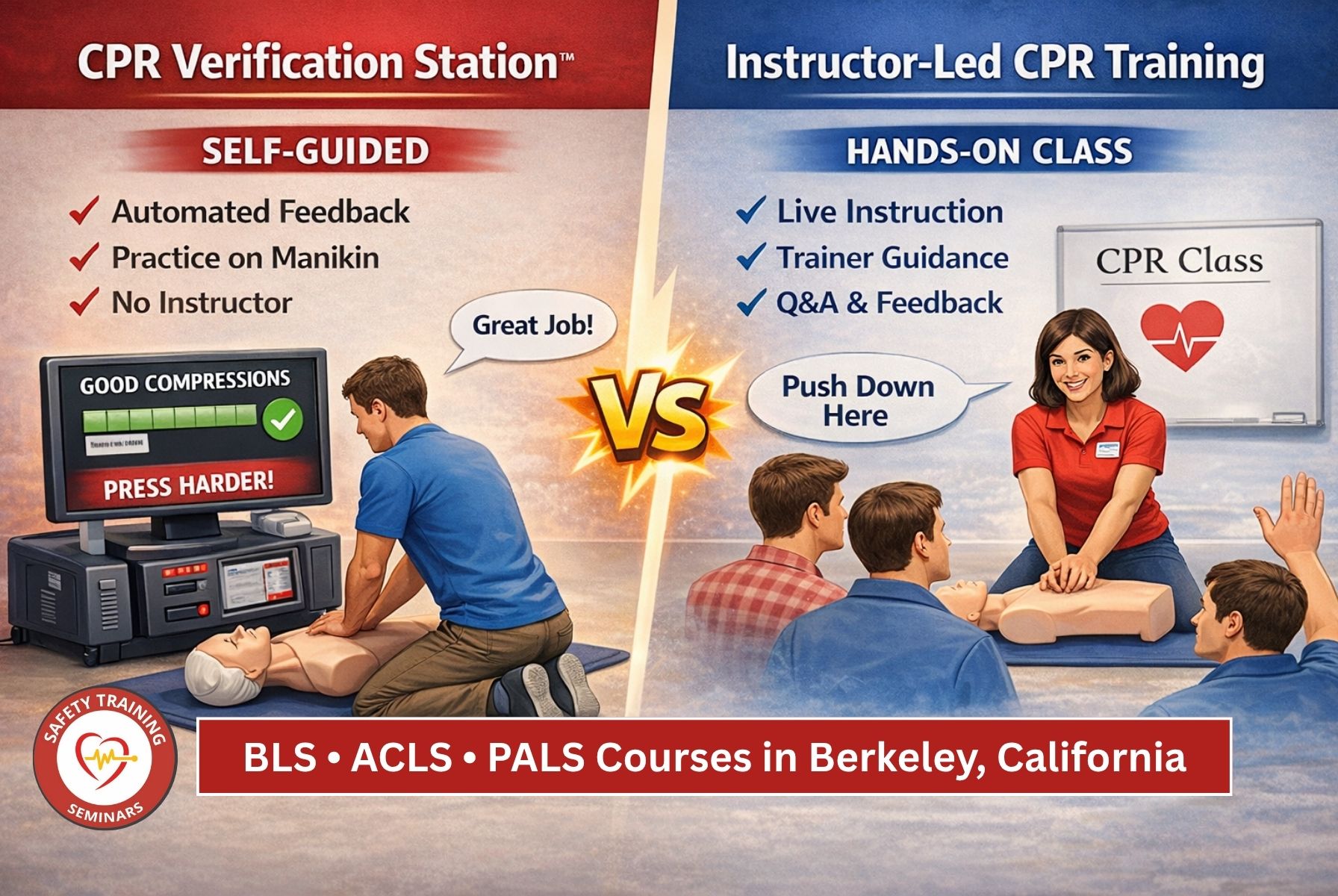
Self-Guided Learning pairs an independent online knowledge portion with hands-on skills practice and testing for provider-level courses. You control the pace of the study portion, then complete the in-person requirement at a scheduled time. It tends to suit people juggling clinical hours, class schedules, or irregular shifts.
Traditional classroom training keeps everything in one place: a scheduled session led by an instructor, with knowledge instruction and skills practice happening together. Some learners prefer the structure and the chance to ask questions in real time.
Online-only training delivers the knowledge portion alone. For courses that require a hands-on skills check, an online-only certificate may not satisfy the requirement. That’s the trade-off to watch — a fully online option can look convenient but may not be accepted where a hands-on component is expected.
No single format is better for everyone. The right choice depends on your schedule, how you learn, and what your employer or school will recognize.
Training Situations Around Berkeley
Berkeley draws a mix of learners with different reasons for training. Healthcare workers living here often commute to hospitals in Oakland or across the bay, and their employers may set clear BLS, ACLS, or PALS expectations. Nursing and allied-health students frequently need BLS before starting clinical placements. Teachers, after-school staff, and childcare providers in the area regularly renew CPR and First Aid to stay current with workplace rules. Parents, caregivers, and fitness professionals often look for flexible options that fit around family or gym schedules. Because the East Bay is so interconnected, someone working in a neighboring community may still find a Berkeley class the most practical place to complete a skills session.
Safety Training Seminars in Berkeley
For learners in the area, Safety Training Seminars operates a Berkeley location where you can look into course options that match your role. The center is located at 1700 Solano Ave, Suite F, Berkeley, CA 94707.
When you’re deciding where to train, a local option can simplify the hands-on portion of a Self-Guided course — you complete the online study wherever you like, then handle the skills session nearby. Before registering, review the course-specific details, confirm which certification your employer or school requires, and check that the class covers the hands-on skills check if your course needs one. Community members and workplace teams weighing general options can start with CPR and BLS classes in downtown Berkeley to see what’s offered close to home.
What to Verify Before You Enroll
A few checks can save you a repeat class:
- Confirm the exact course name and level your employer, school, or licensing body accepts.
- Ask whether a hands-on skills session is required for your certification.
- Check whether you’ll receive an AHA eCard or another form of course completion documentation.
- Verify any renewal timeline that applies to your role.
If any of these details vary for your profession — and they often do — the safest move is to confirm directly with the organization requesting the certification.
Frequently Asked Questions
What does AHA Self-Guided Learning include? It includes an independent online knowledge portion you complete at your own pace. For provider-level courses like BLS, ACLS, and PALS, it also includes a required in-person skills practice and skills check. The exact structure depends on the specific course, so confirm the format before enrolling.
Can healthcare workers in Berkeley complete BLS through Self-Guided Learning? Yes, BLS is commonly available in a self-guided format, meaning the knowledge portion is done online and the hands-on skills are completed in person. Berkeley-area healthcare workers should confirm with their employer that a self-guided BLS course meets its requirement before signing up.
Is an online-only certification enough for a healthcare job near Berkeley? Often it is not. Many clinical roles require a course with a hands-on skills check, which an online-only certificate may not include. Because acceptance varies by employer and role, verify what your workplace recognizes before choosing an online-only option.
How do I know whether I need CPR or BLS? As a general pattern, CPR/AED courses suit the general public and many workplace roles, while BLS is intended for healthcare professionals and appropriate students. Since requirements differ by job and program, confirm which one your employer or school specifies rather than assuming.
Can someone from a nearby East Bay community train at the Berkeley location? Yes. Learners commuting from surrounding areas often complete their skills session at a convenient Berkeley center. If you live nearby but work elsewhere, just confirm that the course you complete meets the requirement set by the employer or school asking for it.
Choosing Your Next Step
The main thing to keep straight is that Self-Guided Learning is not the same as an online-only class: the study portion is independent, but provider-level courses still expect a hands-on skills check. Start by identifying which certification your role, employer, or school requires, then match it to a training format that fits your schedule. For learners in Berkeley, Safety Training Seminars offers a local option where the in-person portion can be handled close by. Review the course-location page that matches your situation, confirm the specific requirement, and enroll in the version that will actually be accepted for your work or program.